
The Tale of Tiny Tim
“Guys,” I said that evening at the dinner table, “I think I have a bot fly.”
I knew by heart the grisly details. The bot fly is among nature’s more grossly fascinating creatures, and I’d sort of hoped to get one here. An adult fly captures a mosquito in midair, lays its egg on the mosquito’s body, and lets it go. When the mosquito then bites you, the fly’s egg drops on to your warm skin and quickly hatches. The tiny fly larva then burrows into your flesh where, if left unmolested, it will grow into a fearsomely spiny, inch-long grub in eight weeks. The maggot then wriggles out of your skin, pupates in the soil for a while, and eventually develops into an adult fly.
Everyone at the dinner table who had spent a significant amount of time at Tiputini had had one at some point. Brandt once tried to squeeze a bot fly larva out of his forearm, accidentally broke the grub in half, and fought the subsequent infection for a full year. John had once hosted thirteen of them on his back simultaneously. Amy had killed three bot flies on her scalp with superglue after carefully shaving away a patch of her hair; her ex-boyfriend had actually hatched one out of his hip a few years back. But nobody had hosted one recently.
Given that the larva takes a while to grow big enough to notice, I’d likely contracted it within a day or two of arriving in Ecuador. Lucky, I guess!
“Oh! I can see it moving, even without the magnifying glass!” she quickly exclaimed.
“My. God. That is soooo gross!” squeaked Rebekah, who, like me, had never seen a bot fly before.
Abby, who had spent three field seasons working at Tiputini without ever hosting one, merely stared in fascinated silence.
“How’s it feel to be a father?” asked Brant.
They all agreed that I should let my parasite grow for a while before extracting it; that way, it might be easier to remove in one piece.

As I mulled these options over the following days, I began to grow fond of my new friend and named him Tiny Tim.
I felt a certain attachment to him. Tiny Tim accompanied me wherever I went at Tiputini. He never complained much except during my daily shower (understandable, since it cut off his air supply), and I introduced him in turn to everyone at the station, including some appalled study abroad students. Usually, when I pulled up my shirt, Tiny Tim would pop out his breathing tube to say hello within a few seconds. It was kind of fun.
But yesterday my perspective abruptly changed. While watching a group of howler monkeys in the jungle canopy, I noticed one with something strange on its neck. Closer inspection revealed about thirty goose-egg-sized lumps swollen into one disgusting mass around the poor animal’s throat: massive, pus-filled, tormenting, bot flies. It looked awful. Staring back at me, from the throat of a howler monkey, was the dark future of Tiny Tim.
I’d decided on superglue, so, yesterday evening, Abby carefully covered him with a layer of glue while Rebekah (who had been having nightmares in which Tiny Tim grew to more than a foot long) monitored the action in our air-conditioned office. Tiny Tim, for his part, didn’t like this very much and visibly tried to wriggle to the surface while Abby and Rebekah ran play-by-play commentary, but the glue formed an impenetrable, sticky barrier, so he eventually retreated back into his hole to die. I could feel sharp pricks as he writhed in panic, but it was a satisfying feeling. We let the glue set under some athletic tape overnight.
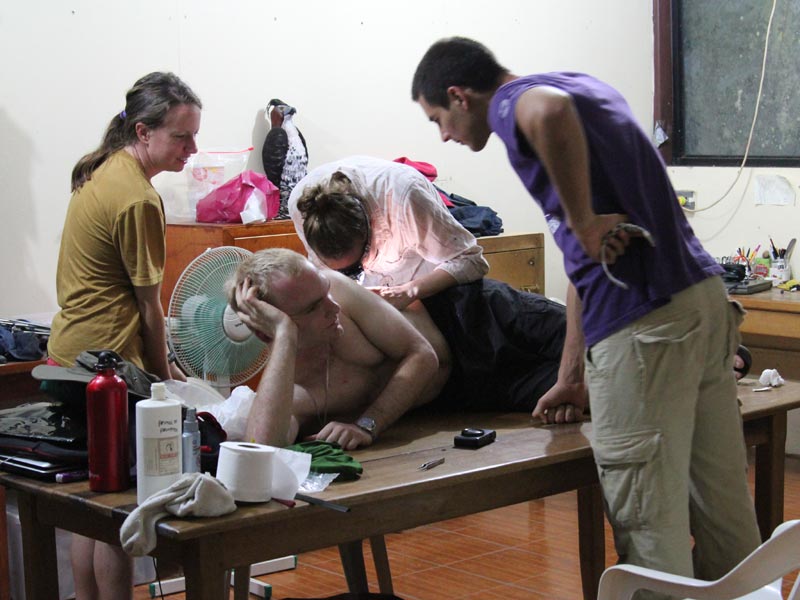
Today, before dinner, half a dozen researchers gathered in anticipation of Tiny Tim’s exhumation. Since he was on my back, Amy volunteered to squeeze him out. As I sprawled facedown on a table in the lab, she peeled off the layer of dried superglue then put a firm finger on each side of the lump and pushed, hard.
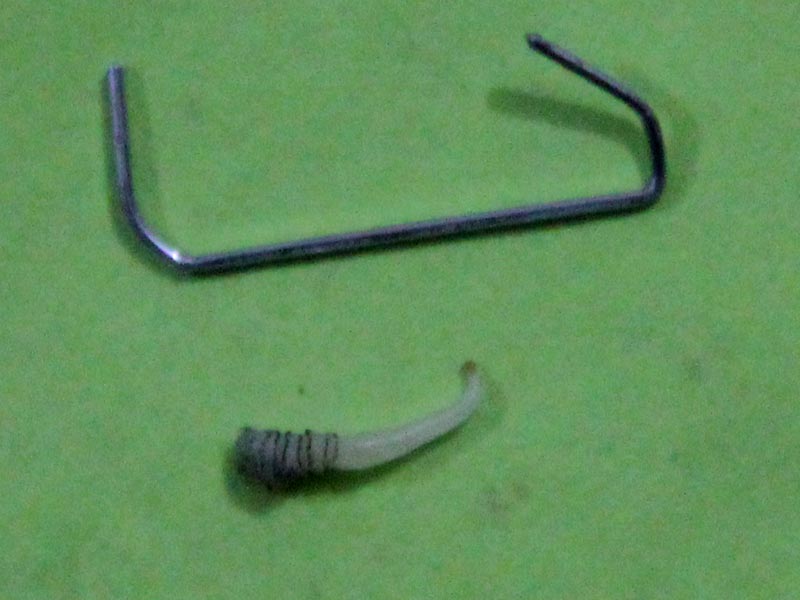
Millimeter by millimeter, Tiny Tim’s suffocated body emerged to a chorus of oohs and aahs. He was still tiny by bot fly standards, and, when I finally got a glimpse of his whole body, I was a bit disappointed. Grasped by a pair of tweezers in the lab’s sterile illumination, he looked frankly pathetic. But under a magnifying glass, I could see rows and rows of sharp spines and an undeniably maggot-like body, all created by a transformation of my own flesh.
Since bot flies don’t want their hosts to die, they produce chemicals to ward off infections and a bot fly complication is rare. Once Tiny Tim was out, my body would heal itself just fine. Rebekah presented me with a purple Hello Kitty band aid and I was good to go. Tiny Tim now resides in a souvenir vial of preservative alcohol on my bedside table.
So, what should I name the next one? Femme Bot?
somehow i’m glad this wasn’t part of your story at rotary! holy cow. the things you get into.
i remember a television show about the bot flies. now i feel privileged to know someone who has had one up close and personal. too amazing. keep the fab stories coming.
Good on ya Noah!
You know, after reading the entire tale, I am just speechless! Hoping your back heals nicely and hoping you DON’T get another one. Seen any great birds lately?
Way to go Noah…I knew you would be a great DAD!!!
Perhaps this is the reason we haven’t seen a new blog from you in several days! A tale told as only you can do, Noah, with pluck and wit!
The detached, scientific approach reduces the Ick Factor by 25%; group participation accounts for another 25%; the very successful outcome (for you, at least) is another big deduction; this still leaves plenty Ick Factor for this very en-gross-ing tale.
Well, Noah, I have dug warbles out of the backs of cattle, seen horse bot fly larvae in horse manure, but I had never even heard of human bot flies. I am *so* glad you are having these amazing adventures and writing so well about them… and I am *so* glad it’s you and not me.
Congratulations, Noah! Maybe the next one will be better placed for observation. I’d think 13 of the little buggers at once would just about put a person over the edge! I can’t imagine…. better wish hard for only one at a time.
Hey Noah. The “comment” glitch fix must have worked, because now I can see and read all comments.
Anne & I found an “easy” Rock Sandpiper today. Under the Hwy 101 bridge in Depoe Bay! Much easier than the one in December at Simpson Reef! Warmer too! It was in the mid-60s today!
Be careful what you eat! And if you don’t, stay hydrated! Keep the posts coming!
Dan
A question, is that staple a standard sized wire staple common in elem. school classrooms?
Dan
I am so glad little Tim was a premie! Labor sounded a bit rough, but relieved that delivery went well!! Did you do Lamaze breathing to get thru it?? What is next for you…. Twins?